I work from my home in Dallas, while my colleagues are spread in offices from San Francisco, Seattle, Sydney, Brisbane, and London. So I set up my work phone extension to forward to my home office phone, which is a virtual "softphone" from Skype, which will then forward to my cell phone if I don't answer on my laptop. Finally, my cell phone will collect a voice mail if I still do not answer, and it will email me that message in an attachment.
Technology to the rescue
At least that's how I thought it worked, until this week when a couple of people told me that they called and received a "Mailbox full" message, even though my cell phone mailbox is empty. I checked with our internal IT and found out that the number of rings my work line waited before going to voice mail was the same as the sum of the number of rings my home office and cell phone waited before recording a message. And so sometimes my work line would take a message, but it wasn't sending me an email since the system was upgraded, and I had no indicator light telling me that I have a message.
So, today and I have 100 unanswered messages going back to January 28th. I apologize to those who think I never return calls, but I also wonder about how much productive time I had recently without all of those interruptions...
My phone solution
In case you have a similarly disconnected life, after much trial-and-error I finally settled on using a Skype In subscription, a Freetalk wireless headset, and a Sprint data card. The quality has been acceptable for business use for the most part, and it keeps me connected anywhere I travel as long as I have Internet or cell phone access. Just be sure to check the forwarding settings every now and again.
Thursday, June 11, 2009


Friday, May 29, 2009
Think you'll never attend a meeting in a Virtual World? Look out behind you!
I've heard meetings expert Corbin Ball speak for several years now about the coming era of Virtual Meetings in Second Life and similar sites. The typical audience response is something close to "not in my lifetime", but Corbin keeps plugging this vision.
I may have been one of the skeptics in Corbin's presentations, but I've recently been converted by three experts in my own house.
Toontown vs. Second Life
The other day I walked over to our computer table to see three of my kids (Kyra age 10, Cade age 9, Izzy age 6) excitedly switching screens and looking over each others' shoulders as they played a new game they discovered at Disney.com - Toontown. Basically, you pick a Disney character to represent yourself, and then you run around a virtual Disney world, talking to other kids' Toontown characters and trying to figure out how to defeat the evil Cogs infecting the world.
To my kids, this environment was more natural than the pictures of real trade shows that I show them when they ask me why I went away last week. Their response is, "You stand in that tiny booth all day waiting for people to come see you?!?"

There is Izzy above, using her dog's name "Ginger" for her Toon.

Izzy talking to a Cog (they are bad).

Izzy talking to a town employee for help.
The Coming World of Virtual Trade Shows
As the Toontown generation becomes the working class, the age of virtual trade shows is inevitable. Inc. magazine recently published an article ("Nice meeting your avatar") on three leading providers: InXpo, Unisfair, and ON24. I've also seen Digitell at the Meetings Tech Expo shows and have explored their version of Active Worlds platform.
I tried the Active Worlds platform but found the experience lacking. There were too many key controls to move around, visiting booths took longer than I was willing to spend, and the booths were too cumbersome to customize (in my opinion). The experience was too close to reality - at a real show I don't mind walking across the floor for five minutes to find a booth, but I'm used to everything being instant at my computer.
The systems will improve, however, and if it's in Inc. this month then it will be in Forbes next year and in Newsweek the year after that. By then you may have attended one yourself. If so, please let me know about your experience.
I may have been one of the skeptics in Corbin's presentations, but I've recently been converted by three experts in my own house.
Toontown vs. Second Life
The other day I walked over to our computer table to see three of my kids (Kyra age 10, Cade age 9, Izzy age 6) excitedly switching screens and looking over each others' shoulders as they played a new game they discovered at Disney.com - Toontown. Basically, you pick a Disney character to represent yourself, and then you run around a virtual Disney world, talking to other kids' Toontown characters and trying to figure out how to defeat the evil Cogs infecting the world.
To my kids, this environment was more natural than the pictures of real trade shows that I show them when they ask me why I went away last week. Their response is, "You stand in that tiny booth all day waiting for people to come see you?!?"

There is Izzy above, using her dog's name "Ginger" for her Toon.

Izzy talking to a Cog (they are bad).

Izzy talking to a town employee for help.
The Coming World of Virtual Trade Shows
As the Toontown generation becomes the working class, the age of virtual trade shows is inevitable. Inc. magazine recently published an article ("Nice meeting your avatar") on three leading providers: InXpo, Unisfair, and ON24. I've also seen Digitell at the Meetings Tech Expo shows and have explored their version of Active Worlds platform.
I tried the Active Worlds platform but found the experience lacking. There were too many key controls to move around, visiting booths took longer than I was willing to spend, and the booths were too cumbersome to customize (in my opinion). The experience was too close to reality - at a real show I don't mind walking across the floor for five minutes to find a booth, but I'm used to everything being instant at my computer.
The systems will improve, however, and if it's in Inc. this month then it will be in Forbes next year and in Newsweek the year after that. By then you may have attended one yourself. If so, please let me know about your experience.
Thursday, May 21, 2009
Society of Government Meeting Professionals 2009 National Education Conference
Last week I attended the 2009 National Education Conference for SGMP in Louisville, Kentucky. Like all trade shows this year, attendance was down by nearly half, and of those about three times as many attendees were suppliers compared to buyers. The meetings world has not stopped, however, and I continue to meet customers who renew their licenses and new prospects who want to make their operations more efficient.
Online Registration Presentation
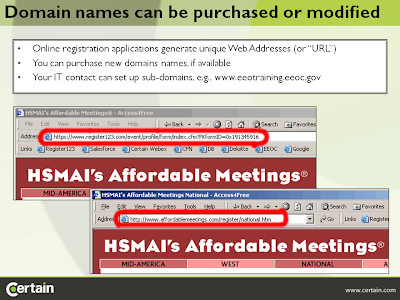
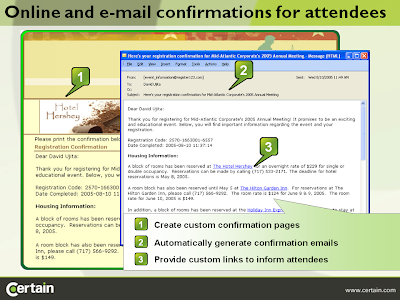
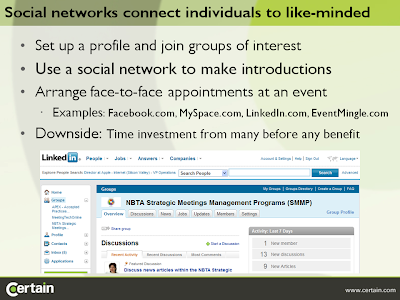
Thursday morning, I spoke on "Online Registration for Government Meetings" with about 60 planners. Below are the slides that I presented.










Online Registration Presentation
Thursday morning, I spoke on "Online Registration for Government Meetings" with about 60 planners. Below are the slides that I presented.


Monday, April 27, 2009
Strange visitors at the door
One interesting aspect of working for a global company is sharing local experiences that seem out of this world to your colleagues.
Here's a photo of a 3 am visitor to the front door of our Support Consultant Julian in Brisbane:

I had a similarly startling experience at my office door last week while on a conference call. I hope that the client didn't hear me snap this photo. (Notice that the "child fence" in the background didn't do its job.)

I don't think that any amount of bad economic news can withstand the smile of a baby (koala or human)!
Here's a photo of a 3 am visitor to the front door of our Support Consultant Julian in Brisbane:

I had a similarly startling experience at my office door last week while on a conference call. I hope that the client didn't hear me snap this photo. (Notice that the "child fence" in the background didn't do its job.)

I don't think that any amount of bad economic news can withstand the smile of a baby (koala or human)!
Wednesday, April 15, 2009
Keep your pre-registration money in your bank account
I have read of a few meeting management companies going bankrupt this year, taking some of their clients' pre-registration revenue with them. Having lived through the event registration carnage of 2001-2004 (remember Event411.com, Procurepoint.com, Bthere.com?), I thought that large event producers had learned to process fees directly into their own bank accounts. Meetings technology companies seem to be stronger this time, but I don't think these will be the last bankruptcies.
If your event produces a substantial amount of money (whose loss would severely hurt your organization) then I suggest you set up an Internet-ready merchant bank account and have your registration service provider process payments directly into your account. This is standard practice for many companies like Certain Software.
Don't trust your vendors bank accounts, and don't trust escrow services as funds can be diverted by criminal or accidental negligence.
If your event produces a substantial amount of money (whose loss would severely hurt your organization) then I suggest you set up an Internet-ready merchant bank account and have your registration service provider process payments directly into your account. This is standard practice for many companies like Certain Software.
Don't trust your vendors bank accounts, and don't trust escrow services as funds can be diverted by criminal or accidental negligence.
Subscribe to:
Posts (Atom)

